Designing for Employees
Service design and business case project to transform HR processes and systems for 14,000 employees. Deliverables included creating a business case for HR transformation.
Scroll to impact

Role
Service Designer
Researcher
Team
CX Manager
Board of Directors
Product Manager
IT Team
HR
Finance
Project Overview
I was tasked with leading a project to transform the HR function of a large bank with over 14,000 employees and growing operational pressure.
While leadership acknowledged the problems, they couldn’t pinpoint their origin. Systems were clunky, workflows were manual, and employee journeys were fragmented, but no one had a clear map of what was broken, or how deeply it was affecting the organisation.
Aligning Stakeholders
Before jumping into redesign, we had to address something fundamental: a lack of shared understanding. The HR department was sprawling, with siloed teams using their own tools and processes. Collaboration was limited, and even agreeing on “how things work” became a challenge.
To fix this, I started by mapping all HR stakeholders and their functional areas. This created visibility into who was responsible for what, and revealed gaps in ownership, duplication of effort, and missed opportunities for collaboration.
Stakeholder map to identify areas of responsibilites.
Mapping the Ecosystem
Through a two-day discovery workshop, I brought together HR executives, managers, and frontline staff to discuss the day-to-day challenges they faced. Each team was describing different tools, systems, and pain points. No one had a full picture. To bring clarity, I created a comprehensive HR ecosystem map.
It revealed 14 different platforms used across various HR functions, none of them integrated, many of them redundant. And without a clear system view, no one could see how one inefficiency triggered another.
This mapping exercise made the invisible visible, giving stakeholders a shared understanding of the system, and uncovering hidden complexities that had long gone unnoticed. It was the first major step in shifting from fragmented experience to holistic transformation.
Pain point analysis across 19 different HR journeys.
Ecosystem map to visualize problems across all functions, systems, process.
The core issues stemmed from manual, paper-based workflows, siloed systems, and limited visibility.
Policy Review and Setting Benchmarks
To arrive to concrete recommendations, I reviewed HR policies across the lifecycle and mapped them against leading HR platforms. The scan included 91 functionalities, beyond just feature comparisons. The features were divided in Must Haves, Value Additions and New Horizons. Assessing the platforms was crucial for recommending the right implementation partner.
Benchmarking across internal processes and systems.
Financial Impact
Collaborating closely with business analysts, I played a key role in formulating the business case. Together, we calculated the financial implications of the existing journeys, and introducing new ones. Every journey was broken down into direct and indirect KPIs that effected the bank. Through data, each KPI was assigned monetary values, to finally conclude the costs (and potential savings) incurred to the bank
By quantifying the potential monetary gains and contrasting them with the associated costs, we provided a clear picture of how the current state and the recommendations affected the bottom-line. (A sample simplified impact of one of the journeys is explained below)
This strategic approach ensured informed decision-making and highlighted the tangible benefits of implementing these solutions.
Thanks for reading.
See my other work.
Next: Design for Cities


afira.chishty@gmail.com
Designing for Employees
Service design and business case project to transform HR processes and systems for 14,000 employees. Deliverables included creating a business case for HR transformation.
Scroll to impact
Role
Service Designer
Researcher
Team
Product Manager
CX Manager
IT Team
Board of Directors
HR
Finance
Project Overview
I was tasked with leading a project to transform the HR function of a large bank with over 14,000 employees and growing operational pressure.
While leadership acknowledged the problems, they couldn’t pinpoint their origin. Systems were clunky, workflows were manual, and employee journeys were fragmented, but no one had a clear map of what was broken, or how deeply it was affecting the organisation.
Aligning Stakeholders
Before jumping into redesign, we had to address something fundamental: a lack of shared understanding. The HR department was sprawling, with siloed teams using their own tools and processes. Collaboration was limited, and even agreeing on “how things work” became a challenge.
To fix this, I started by mapping all HR stakeholders and their functional areas. This created visibility into who was responsible for what, and revealed gaps in ownership, duplication of effort, and missed opportunities for collaboration.
Stakeholder map to identify areas of responsibilites.
Mapping the Ecosystem
Through a two-day discovery workshop, I brought together HR executives, managers, and frontline staff to discuss the day-to-day challenges they faced. Each team was describing different tools, systems, and pain points. No one had a full picture. To bring clarity, I created a comprehensive HR ecosystem map.
It revealed 14 different platforms used across various HR functions, none of them integrated, many of them redundant. And without a clear system view, no one could see how one inefficiency triggered another.
This mapping exercise made the invisible visible, giving stakeholders a shared understanding of the system, and uncovering hidden complexities that had long gone unnoticed. It was the first major step in shifting from fragmented experience to holistic transformation.
Pain point analysis across 19 different HR journeys.
Ecosystem map to visualize problems across all functions, systems, process.
The core issues stemmed from manual, paper-based workflows, siloed systems, and limited visibility.
Policy Review and Setting Benchmarks
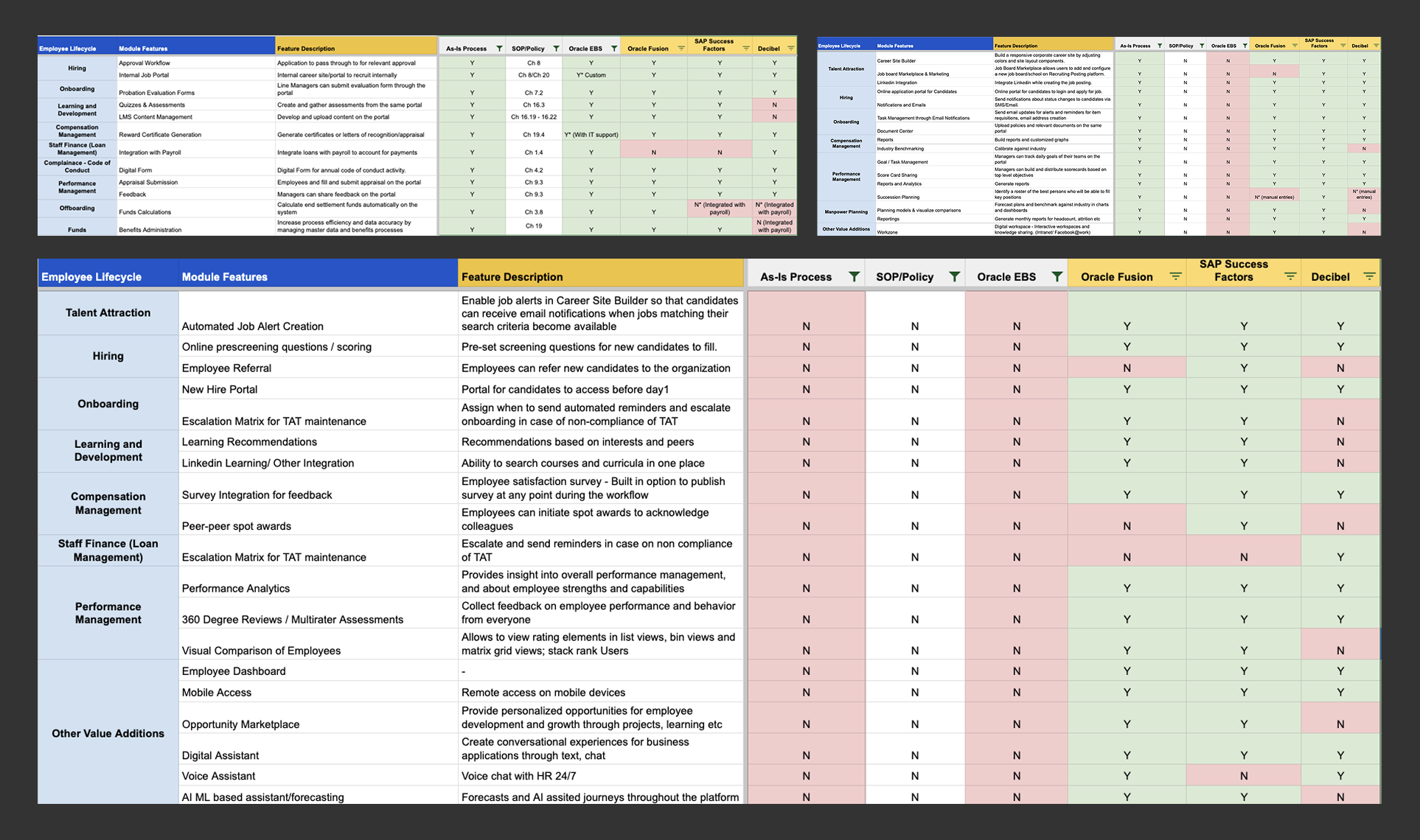
To arrive to concrete recommendations, I reviewed HR policies across the lifecycle and mapped them against leading HR platforms. The scan included 91 functionalities, beyond just feature comparisons. The features were divided in Must Haves, Value Additions and New Horizons. Assessing the platforms was crucial for recommending the right implementation partner.
Benchmarking across internal processes and systems.
Financial Impact
Collaborating closely with business analysts, I played a key role in formulating the business case. Together, we calculated the financial implications of the existing journeys, and introducing new ones. Every journey was broken down into direct and indirect KPIs that effected the bank. Through data, each KPI was assigned monetary values, to finally conclude the costs (and potential savings) incurred to the bank
By quantifying the potential monetary gains and contrasting them with the associated costs, we provided a clear picture of how the current state and the recommendations affected the bottom-line. (A sample simplified impact of one of the journeys is explained below)
This strategic approach ensured informed decision-making and highlighted the tangible benefits of implementing these solutions.
Thanks for reading.
See my other work.
Next: Design for Cities
afira.chishty@gmail.com
Designing for Employees
Service design and business case project to transform HR processes and systems for 14,000 employees. Deliverables included creating a business case for HR transformation.
Scroll to impact
Role
Service Designer
Researcher
Team
CX Manager
Board of Directors
Product Manager
IT Team
HR
Finance
Project Overview
I was tasked with leading a project to transform the HR function of a large bank with over 14,000 employees and growing operational pressure.
While leadership acknowledged the problems, they couldn’t pinpoint their origin. Systems were clunky, workflows were manual, and employee journeys were fragmented, but no one had a clear map of what was broken, or how deeply it was affecting the organisation.
Aligning Stakeholders
Before jumping into redesign, we had to address something fundamental: a lack of shared understanding. The HR department was sprawling, with siloed teams using their own tools and processes. Collaboration was limited, and even agreeing on “how things work” became a challenge.
To fix this, I started by mapping all HR stakeholders and their functional areas. This created visibility into who was responsible for what, and revealed gaps in ownership, duplication of effort, and missed opportunities for collaboration.
Stakeholder map to identify areas of responsibilites.
Mapping the Ecosystem
Through a two-day discovery workshop, I brought together HR executives, managers, and frontline staff to discuss the day-to-day challenges they faced. Each team was describing different tools, systems, and pain points. No one had a full picture. To bring clarity, I created a comprehensive HR ecosystem map.
It revealed 14 different platforms used across various HR functions, none of them integrated, many of them redundant. And without a clear system view, no one could see how one inefficiency triggered another.
This mapping exercise made the invisible visible, giving stakeholders a shared understanding of the system, and uncovering hidden complexities that had long gone unnoticed. It was the first major step in shifting from fragmented experience to holistic transformation.
Pain point analysis across 19 different HR journeys.
Ecosystem map to visualize problems across all functions, systems, process.
The core issues stemmed from manual, paper-based workflows, siloed systems, and limited visibility.
Policy Review and Setting Benchmarks
To arrive to concrete recommendations, I reviewed HR policies across the lifecycle and mapped them against leading HR platforms. The scan included 91 functionalities, beyond just feature comparisons. The features were divided in Must Haves, Value Additions and New Horizons. Assessing the platforms was crucial for recommending the right implementation partner.
Benchmarking across internal processes and systems.
Financial Impact
Collaborating closely with business analysts, I played a key role in formulating the business case. Together, we calculated the financial implications of the existing journeys, and introducing new ones. Every journey was broken down into direct and indirect KPIs that effected the bank. Through data, each KPI was assigned monetary values, to finally conclude the costs (and potential savings) incurred to the bank
By quantifying the potential monetary gains and contrasting them with the associated costs, we provided a clear picture of how the current state and the recommendations affected the bottom-line. (A sample simplified impact of one of the journeys is explained below)
This strategic approach ensured informed decision-making and highlighted the tangible benefits of implementing these solutions.
Thanks for reading. See my other work.
Next: Design for Cities
afira.chishty@gmail.com