Designing for Investors
Designed and shipped a tokenized credit platform MVP, from UX flows to a live demo product using AI-assisted workflows end to end.
Scroll to final design

Role
User Researcher
Design Engineer
Team
CreditBook Founders
Design Lead
Data & Analytics Lead
Engineering Lead
Overview
Oryn is a tokenized credit platform built on CreditBook's SME lending infrastructure, offering investors 8–12% annual returns from real-world loans. The ask was to take the product from zero to a live demo, something investors could actually experience and drive waitlist signups ahead of a fundraise.
There was no existing design, no dev team to hand off to, and a tight timeline. I owned the process entirely: research, UX, visual design, and production of the demo environment.
Challenge
Oryn had two very different users to design for at the same time. Retail investors needed a simple, low-friction entry point, something that built trust quickly without requiring a finance background. Institutional investors needed depth: portfolio composition, loan-level transparency, risk data, and auditability. The challenge was designing one cohesive experience that could serve both without watering down either.
I designed a dedicated expert mode, giving institutional investors the ability to drill down into loan-level data without surfacing that complexity by default.
Expert mode feature to help users drill down on each loan within a fund without compromising clarity for one user group.
Design and Dev
I used an AI-assisted design-to-production pipeline throughout: Figma for UX flows and visual design, Figma MCP to bridge design intent directly into code, Claude Code and Cursor for implementation and refinement, and GitHub for version control. Working this way let me move fast without losing design fidelity. What would typically require a separate dev hand-off and multiple rounds of QA was compressed into a much tighter loop - design, implement, refine, ship.
The product demo covered the full investor MVP journey: investing into a verified credit fund, tracking individual loans with full transparency controls, and collecting yield. The transparency layer was the hardest part to get right. Institutional investors needed to see bureau checks, compliance approvals, credit scorecards, and downloadable underwriting data. Retail investors needed none of that upfront. The design had to make depth available without making it the default.
All components were built to design system standards, with consistent spacing, tokens, and visual hierarchy throughout.
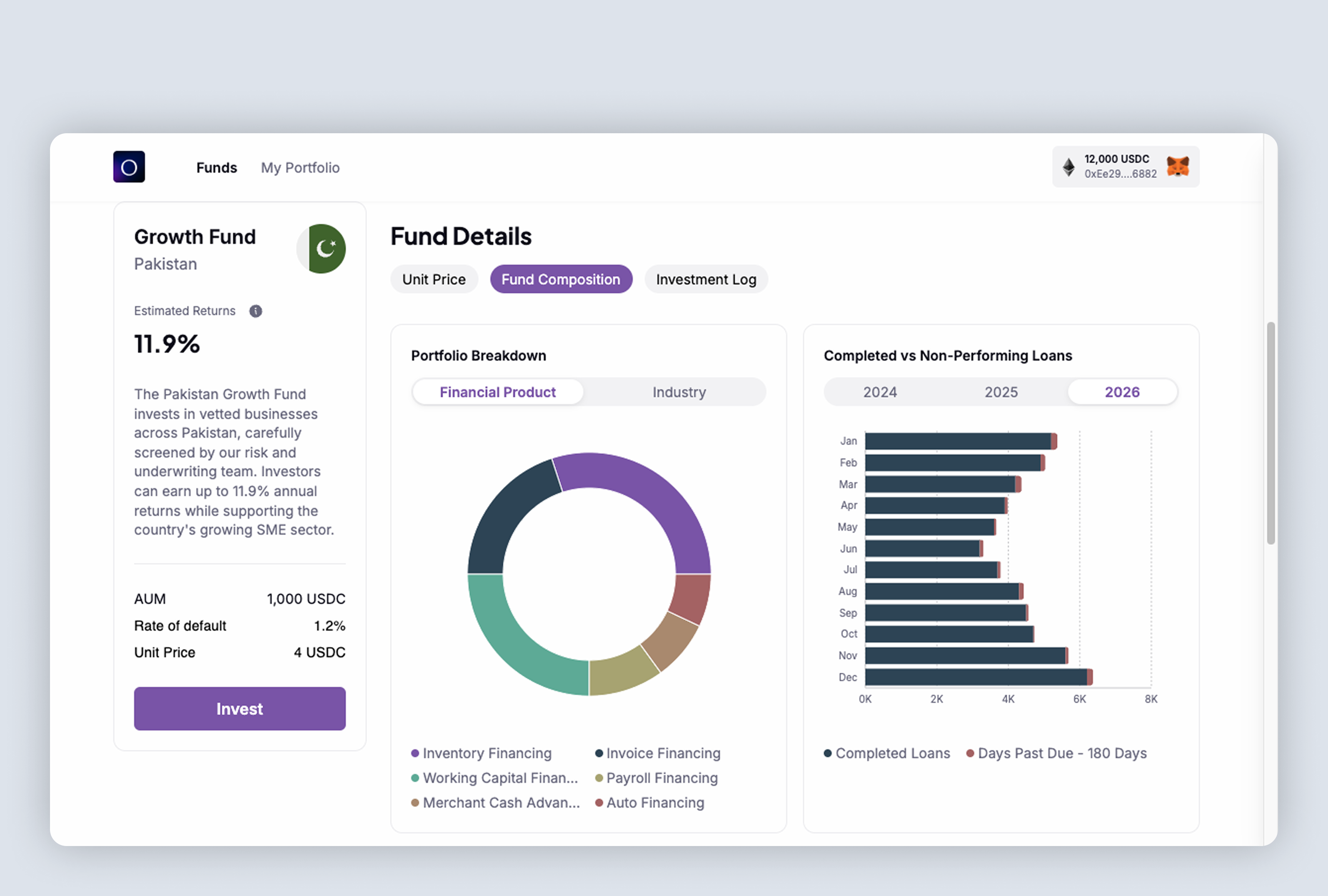
Some screenshots from final design that showcase the details page, portfolio page and investment journey.
Outcome
Achieved the bar for a novel product. Across the project, I interviewed around 15 retail and institutional investors and used their feedback to pressure-test the layouts and flows at each stage. By the final session the consistent thread across almost every session was the same: the product felt simple and clear. For a financial product dealing with tokenized credit, that was the bar we were trying to set.
Setting standards for design-dev workflows. The work served as a proof-of-concept also pushed AI-assisted design workflows forward across other products at CreditBook, the pipeline of Figma to Claude Code to production became a reference point for how the team could move faster without losing design quality.
Thanks for reading.
See my other work.
Design for Scale


afira.chishty@gmail.com
Designing for Investors
Designed and shipped a tokenized credit platform MVP, from UX flows to a live demo product using AI-assisted workflows end to end.
Scroll to final design
Role
User Researcher
Design Engineer
Team
CreditBook Founders
Design Lead
Board of Directors
Data & Analytics Lead
Engineering Lead
Overview
Oryn is a tokenized credit platform built on CreditBook's SME lending infrastructure, offering investors 8–12% annual returns from real-world loans. The ask was to take the product from zero to a live demo, something investors could actually experience and drive waitlist signups ahead of a fundraise.
There was no existing design, no dev team to hand off to, and a tight timeline. I owned the process entirely: research, UX, visual design, and production of the demo environment.
Challenge
Oryn had two very different users to design for at the same time. Retail investors needed a simple, low-friction entry point, something that built trust quickly without requiring a finance background. Institutional investors needed depth: portfolio composition, loan-level transparency, risk data, and auditability. The challenge was designing one cohesive experience that could serve both without watering down either.
I designed a dedicated expert mode, giving institutional investors the ability to drill down into loan-level data without surfacing that complexity by default.
Expert mode feature to help users drill down on each loan within a fund without compromising clarity for one user group.
Design and Dev
I used an AI-assisted design-to-production pipeline throughout: Figma for UX flows and visual design, Figma MCP to bridge design intent directly into code, Claude Code and Cursor for implementation and refinement, and GitHub for version control. Working this way let me move fast without losing design fidelity. What would typically require a separate dev hand-off and multiple rounds of QA was compressed into a much tighter loop - design, implement, refine, ship.
The product demo covered the full investor MVP journey: investing into a verified credit fund, tracking individual loans with full transparency controls, and collecting yield. The transparency layer was the hardest part to get right. Institutional investors needed to see bureau checks, compliance approvals, credit scorecards, and downloadable underwriting data. Retail investors needed none of that upfront. The design had to make depth available without making it the default.
All components were built to design system standards, with consistent spacing, tokens, and visual hierarchy throughout.
Some screenshots from final design that showcase the details page, portfolio page and investment journey.
Outcome
Achieved the bar for a novel product. Across the project, I interviewed around 15 retail and institutional investors and used their feedback to pressure-test the layouts and flows at each stage. By the final session the consistent thread across almost every session was the same: the product felt simple and clear. For a financial product dealing with tokenized credit, that was the bar we were trying to set.
Setting standards for design-dev workflows. The work served as a proof-of-concept also pushed AI-assisted design workflows forward across other products at CreditBook, the pipeline of Figma to Claude Code to production became a reference point for how the team could move faster without losing design quality.
Thanks for reading. See my other work.
Next: Design for Scale
afira.chishty@gmail.com
Designing for Investors
Designed and shipped a tokenized credit platform MVP, from UX flows to a live demo product using AI-assisted workflows end to end.
Scroll to final design
Role
User Researcher
Design Engineer
Team
CreditBook Founders
Design Lead
Data & Analytics Lead
Engineering Lead
Overview
Oryn is a tokenized credit platform built on CreditBook's SME lending infrastructure, offering investors 8–12% annual returns from real-world loans. The ask was to take the product from zero to a live demo, something investors could actually experience and drive waitlist signups ahead of a fundraise.
There was no existing design, no dev team to hand off to, and a tight timeline. I owned the process entirely: research, UX, visual design, and production of the demo environment.
Challenge
Oryn had two very different users to design for at the same time. Retail investors needed a simple, low-friction entry point, something that built trust quickly without requiring a finance background. Institutional investors needed depth: portfolio composition, loan-level transparency, risk data, and auditability. The challenge was designing one cohesive experience that could serve both without watering down either.
I designed a dedicated expert mode, giving institutional investors the ability to drill down into loan-level data without surfacing that complexity by default.
Expert mode feature to help users drill down on each loan within a fund without compromising clarity for one user group.
Design and Dev
I used an AI-assisted design-to-production pipeline throughout: Figma for UX flows and visual design, Figma MCP to bridge design intent directly into code, Claude Code and Cursor for implementation and refinement, and GitHub for version control. Working this way let me move fast without losing design fidelity. What would typically require a separate dev hand-off and multiple rounds of QA was compressed into a much tighter loop - design, implement, refine, ship.
The product demo covered the full investor MVP journey: investing into a verified credit fund, tracking individual loans with full transparency controls, and collecting yield. The transparency layer was the hardest part to get right. Institutional investors needed to see bureau checks, compliance approvals, credit scorecards, and downloadable underwriting data. Retail investors needed none of that upfront. The design had to make depth available without making it the default.
All components were built to design system standards, with consistent spacing, tokens, and visual hierarchy throughout.
Some screenshots from final design that showcase the details page, portfolio page and investment journey.
Outcome
Achieved the bar for a novel product. Across the project, I interviewed around 15 retail and institutional investors and used their feedback to pressure-test the layouts and flows at each stage. By the final session the consistent thread across almost every session was the same: the product felt simple and clear. For a financial product dealing with tokenized credit, that was the bar we were trying to set.
Setting standards for design-dev workflows. The work served as a proof-of-concept also pushed AI-assisted design workflows forward across other products at CreditBook, the pipeline of Figma to Claude Code to production became a reference point for how the team could move faster without losing design quality.
Thanks for reading. See my other work.
Next: Design for Scale
afira.chishty@gmail.com